🔀 The FinEdg arbitrage engine
Measure the gap, then decide if it exists.
The engine records what fifteen venues quote at the same minute, replays the day to see why a gap did not become money, and holds a paper book that opens both legs when the executable spread is wide enough and closes them on the same order books. At 22:00 UTC on 30 October 2026 that book had closed 6,803 pairs for +$3,003.96 after fees on $100 legs — an average of 44.16 bps per pair, with 31.7% of the gross paid in fees. No order leaves this system: the single execution door has no exchange adapter registered.
🎯 What the engine is, and what it is not
It is a measurement pipeline with a paper ledger at the end, not a trading bot. Each stage answers one question the previous stage cannot, and every number is derived from an order book rather than from a last price.
It records, it does not guess
A minute snapshot stores the ask, the bid and the 24-hour volume per venue. A gap is computed from the price you can actually pay and the price you can actually receive, not from the print of the last trade.
It shows the funnel
Signals → pairs with a book on both legs → sizes the book can carry → fills after four fees. Most gaps die at the second step, and the day replay says so out loud.
It keeps a book that loses
The paper book publishes losing days next to winning ones, open results apart from closed ones, and the ledger timestamp so a stopped feed cannot pass for a live one.
It compares rules on one market
Two rule variants and eight ladder arms are stepped over the same stored snapshot. Two replays of the same bytes give the same result, so a verdict can be re-derived by anyone.
It prices the live rules too
The shadow report re-prices the paper signals under the live configuration — five venues, verified bases, smaller legs, real taker rates — and counts the signals the gates would refuse.
It has one closed door
Every order path would go through a single function. No exchange adapter is registered in a running process, so the door is closed by construction, not by a flag somebody could flip.
🧩 Every part of the system
| Module | What it does |
|---|---|
| Spread recorder | Writes a minute snapshot per venue — last price, ask, bid, executable gap, 24-hour volume — and the series lifetime of each pair. Retention is 30 days with a 3 GB cap, so history is a rolling cut, not an archive. |
| Day replay | Turns a day of recorded gaps into a funnel: how many were real, how many had a book on both legs, how much the book could carry, what remained after four fees. Money is counted only from book prices. |
| Forward paper book | Holds a perp-perp position: long the cheap venue at the ask, short the expensive one at the bid, each minute re-marked on both books, closed on convergence or after 24 hours. |
| Rules A/B | Two rule variants see the same minute snapshot, each writes its own ledger, and the winner rule is declared before the start — because comparing different days compares the market, not the rule. |
| Variant ladder | Eight arms stepped over one stored snapshot: entry floor, exit, holding time, size. Deterministic replay means two runs over the same bytes produce identical arm ledgers. |
| Depth observer | Walks the book to say how large a leg can be before the price moves against you. Delayed books are timestamped; a snapshot is never reported as a fill. |
| Shadow of live rules | Paper signals re-priced as the live engine would see them: five venues, verified bases only, $25–50 legs, real taker fees, and the gates that would refuse a signal. |
| Cross-rate graph | Looks for cycles of three or more legs that a pair comparison cannot see, inside one venue or across quote assets. Offline and cheap, because every extra leg is another taker fee. |
| Rehearsal | Runs the live engine on live books and live margin with paper fills, so the first real run is not also the first run. |
| Execution door | One function is the only place an order could leave. It carries leg-risk, a ledger and the gates; with no adapter registered it refuses instead of guessing. |
| Venue adapters | Eight adapters — BingX, Bitget, Bitget UTA, BloFin, Bybit, Gate, KuCoin, OKX — and one shared size arithmetic, because “0.5” means different amounts on different exchanges. |
| Paper accounts | A virtual balance on 13 venues that fills against the real book: buy at the ask, sell at the bid, fee per venue and per market, no book means the order is refused rather than priced out of thin air. |
| Spread alerts | Delivers the same recorded fact to Telegram. Off by default, dry-run by default: without an explicit switch nothing is sent and the reason is written down. |
| Relays | Read-only endpoints for the day replay and the forward book, a status endpoint for the live engine, and a stop-only endpoint. Nothing there can open a position. |
| Terminal screen | Five tabs — monitor, learn, the divergence feed, day replay, forward test — each labelled with the tier that can open it. |
🖼️ The published book
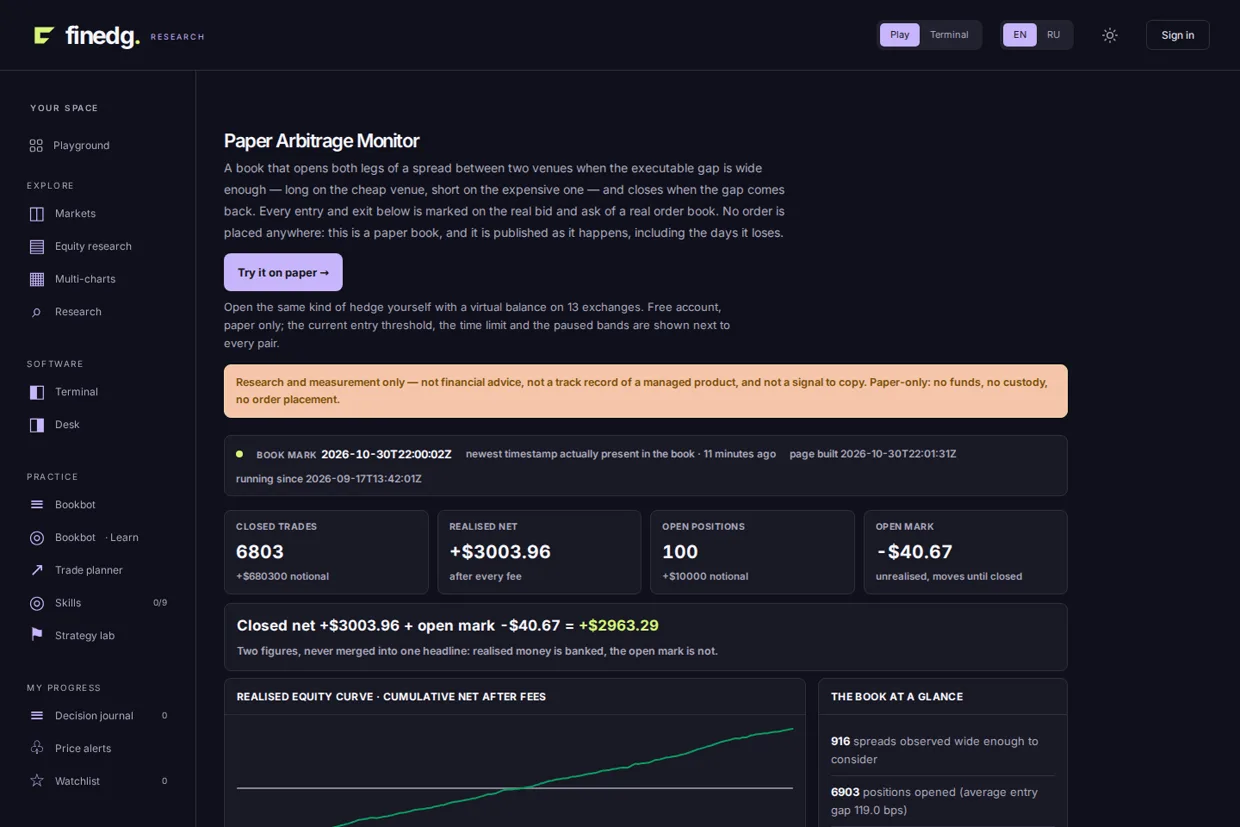
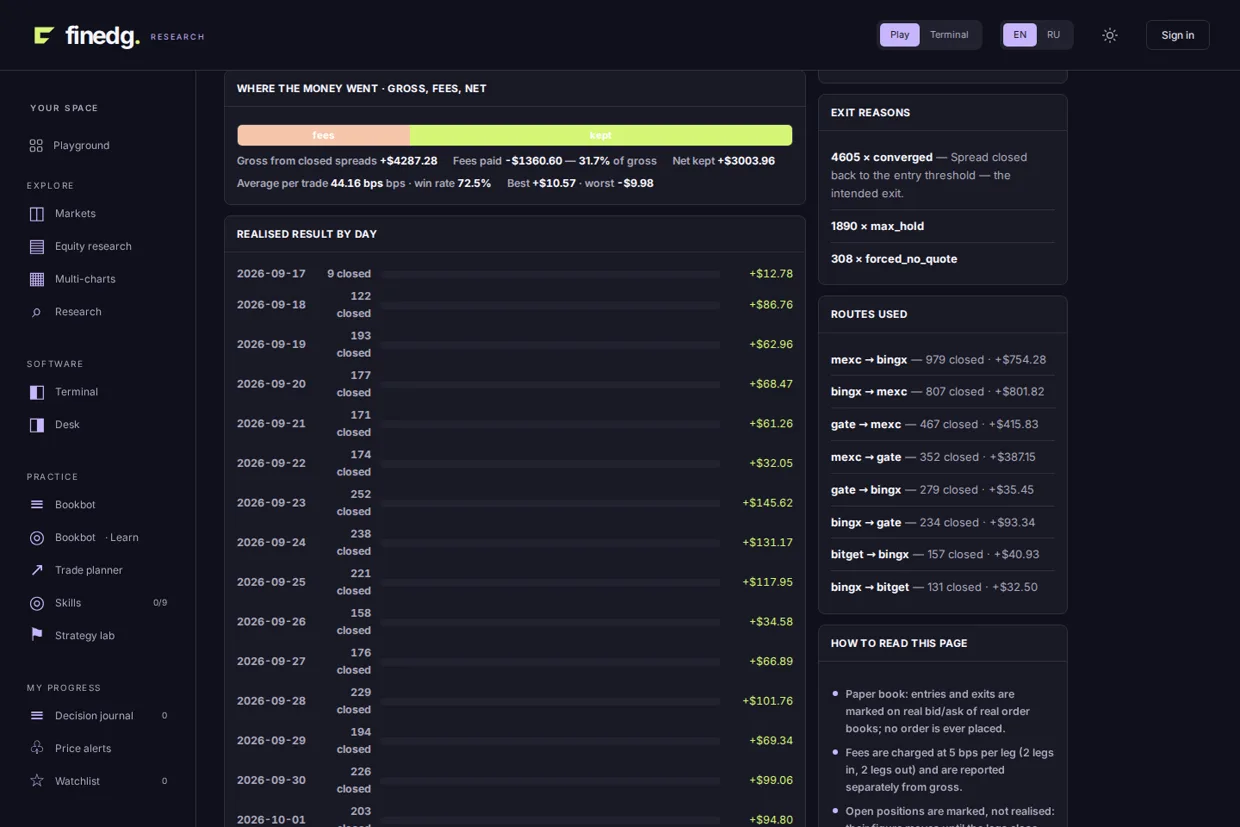
Both screenshots are the public page at /finedg/monitor; the numbers move every minute, the model does not.
⚖️ The rule, written before the result
| Parameter | Value and why |
|---|---|
| Entry gap | At least 50 bps executable, at most 300 bps. The floor started at 30 bps and was raised on 22 September 2026; the ceiling exists because a gap above 3% is almost always a different token under one ticker or a closed transfer. |
| Two runs in a row | A gap must survive two consecutive minute runs, the previous no earlier than 90 seconds before — a one-minute flicker is not caught by a human and must not be caught by the book either. |
| Exit | Close when the closing cost is zero or better; otherwise after 24 hours. A pair that loses its quote exits at the last mark minus 1% of the leg, and says so. |
| Size | $100 per leg, at most 100 open positions, and a leg no larger than 0.1% of the thinner venue's 24-hour volume. |
| Fees | 5 bps taker on each of four sides, charged per pair and reported on its own line; funding is counted inside an eight-hour window. |
| Ladder guards | A book older than 15 seconds is not this minute's market; two legs priced more than 10 seconds apart are two different moments; a “spread” above 10% is a unit mismatch, never an edge. |
📊 The book at 22:00 UTC, 30 October 2026
| Figure | Value | How it is counted |
|---|---|---|
| Closed pairs | 6,803 · $680,300 notional | Pairs closed since 17 September 2026, $100 per leg |
| Gross | +$4,287.28 | Exit book price minus entry book price, before costs |
| Fees | −$1,360.60 (31.7% of gross) | 5 bps on each of four sides, per pair |
| Net closed | +$3,003.96 · 44.16 bps average | After fees; 72.5% of pairs positive, best +$10.57, worst −$9.98 |
| Open | 100 pairs · $10,000 notional · −$40.67 mark | Marked, not realised; moves until closed |
| Exits | 4,605 converged · 1,890 max hold · 308 without a quote | Why each pair closed |
| Recorded gaps | 7.28M opportunities · 14.58M snapshots · 1,599 pair keys | Rolling 30-day cut across 15 venues |
The closed figure and the open mark are never added into one headline on the monitor: realised paper money is banked, an open mark is not. The sum is shown separately, and so is the reason it is not a result.
⚙️ How it runs
| Layer | What is used |
|---|---|
| Language | Python modules in the research tree; the paper path imports no exchange trading client and no model. |
| Storage | SQLite: the spread history, the forward book, per-arm ladder database files and the A/B ledgers. Growing files live on a mounted volume. |
| Schedule | A minute cron records the snapshot and steps the forward book; a nightly job prunes history to the 30-day / 3 GB budget. Heavy collection runs on a separate host. |
| Guards | AST tests refuse an import of a trading client or an LLM inside the paper modules; the execution door is the only place an order can be built. |
| Publishing | Go relays read the same ledgers for the terminal and the public monitor; the monitor reports the ledger timestamp it actually saw. |
🔑 What you can open today
| Address | Who | What you see |
|---|---|---|
| /arbitrage | Everyone | What the gap is, the three numbers that get confused, and the cost calculator |
| /finedg/monitor | Everyone | The live paper book with its ledger timestamp |
| /finedg/evidence | Everyone | The evidence ledger the numbers are checked against |
| /app/v2?screen=arb | Signed-in members | The paper arbitrage screen; entries are filled on real books with virtual money |
| Divergence feed, day replay, forward test | Operators | Recorded divergences with executable prices and the funnel behind them |
Members signing in with Google or Microsoft get the paper screen; the operator tabs answer with an access message rather than data, and that message names the tier instead of pretending the feed is empty.
⚠️ When this does NOT work
Paper fills at the best level.
The book assumes a fill at the best quoted price plus 2 bps. A real 100-dollar leg can walk deeper, and the paper model does not.
Fees here are a project rule.
5 bps per side is a conservative flat rate. Fee tiers differ per venue and per account, and rebates are not modelled at all.
Funding is only partly counted.
Funding is charged inside an eight-hour window; a pair held across a funding change on one leg only is not fully represented.
Transfers are not verified.
The spot model assumes balances already sit on both venues. Moving them costs money and time, and neither is proven here.
The live door is closed.
No exchange adapter is registered in a running process, so the live engine cannot send an order. A closed door is not a guarantee of profit if it were open.
History is a rolling cut.
Retention is 30 days and a 3 GB cap, so the published history is a window, not a complete archive.
❓ Questions
Does the arbitrage engine trade real money?
No. Every measurement comes from paper books filled against real order books with fees charged. The execution door exists in code but has no exchange adapter registered, so it cannot send an order.
Why does a +44 bps average still not mean profit?
It is a paper result on $100 legs at the best quoted level plus two basis points with a flat five basis points per side. Real fills, funding, transfers and the queue are not proven, and fees already took about a third of the gross.
Can I see the numbers without an account?
Yes. The paper book at /finedg/monitor is public: ledger timestamp, gross and fees on separate lines, closed and open results apart, losing days included.
What is the difference between the feed and the book?
The feed lists recorded divergences with the executable price; the book holds the positions those signals would have created and closes them on the same books. The feed is operator-gated today; the book is public.
Figures: published paper book, ledger 2026-10-30 22:00:02 UTC, monitor page built 22:01:31 UTC, read 2026-10-30. Model constants read from the engine source on the same date: entry floor 50 bps (30 bps until 2026-09-22), ceiling 300 bps, two consecutive runs with a 90-second gap, close on zero cost or after 24 hours, forced exit without a quote −100 bps, $100 per leg, 100 open positions, 5 bps per side, 0.1% of 24-hour volume, funding window 8 hours. Spread history: 7.28M opportunity rows, 14.58M snapshot rows, 1,599 tracked pair keys, 15 venues, retention 30 days / 3 GB.
Not financial advice. Paper results do not guarantee live results. Venue names describe where public books were read; they are not endorsements and no account access is involved.