📊 The FinEdg Desk
Spot and futures in one paper book.
finedg.com/desk is the paper trading desk: one screen with a spot workspace and a futures workspace, a deterministic screener, a manual ladder that you drag on the chart, local stops and takes, and a printed reconciliation state when something does not add up. You sign in with the Google or Microsoft account you already use on FinEdg and get a $10,000 paper account of your own. No exchange key is asked for, and no order leaves the building.
🎯 What you get
The desk is a simulator with an honest memory: every order, fill and stop is written to a ledger that survives the browser tab, and every safety number is computed from that ledger rather than typed into the page.
Two markets, one shell
Switch between a spot workspace and a futures workspace without changing the page. They keep separate ledgers, so a spot position cannot quietly fund a futures one.
A screener with reasons
The candidate list is deterministic: drawdown zone, distance from the recent high and a named reason per row. No score appears without the rule that produced it.
An order you can see
Click a price, pick limit or stop, then drag the entry, stop and take lines. A request is sent when you let go of the line, not while you move it.
Stops marked as local
The chart says local next to a stop, because it is a rule in our paper engine — not an order resting on an exchange.
Disagreement stops trading
If the paper book and the market snapshot disagree, new entries are blocked and the state is printed. Nothing is deleted; an operator resumes entries explicitly and the name is recorded.
Your own account
Orders, positions, journal, presets and favourites live in your own paper account. Another visitor cannot see or spend it.
🧩 What the software is made of
| Module | What it does |
|---|---|
| Desk shell | Market switch (spot / futures), instrument picker, PAPER mode chip, live switch with its reason, and a data-health strip across the top. |
| Account and roles | Your FinEdg session is verified by signature. The operator account opens the shared paper book; everybody else gets an isolated account. A visitor without a session sees the sign-in page. |
| Isolated demo accounts | Each person gets $10,000 of paper money with separate spot, futures, journal and preset storage — including a reset for the demo account only. |
| Deterministic screener | Deep-drawdown zones with an interest score and a printed reason per row; filters are kept in the browser, not in a hidden model. |
| Spot ladder | Limit and stop entries above and below price, several rungs on different levels, aggregated position with average price, fills kept apart, partial closes at 25 / 50 / 100%, sell limited to the base you actually hold. |
| Futures ladder | Size entered as notional with margin and leverage shown separately, limit and stop entries, reduce-only closes, partial closes rounded to whole contracts, one shared risk limit. |
| Risk and inspector | Per-order checks before an order is accepted, fee and break-even arithmetic, and the distance between the stop and the estimated liquidation. |
| Protection and reconciliation | Local stops, protected quantity, last check time, entry halt on disagreement, explicit resume, and a single executor lease so two writers cannot own the same book. |
| Journal, presets, favourites | Saved reasons next to the trade, presets with modelled net reward-to-risk, favourites kept in step across tabs. |
| Hypothesis lab | Stored daily-candle tests; a preset can be created from a hypothesis as a new version, with the live switch staying off. |
| Reports | Portfolio and orders views over the same ledger, an audit CSV export with a checksum header, and per-account state that survives a restart. |
| Background loop | Accounts with an open position or working order keep ticking after the tab is closed, so a stop is not paused by a closed window. |
🖼️ The desk as it runs
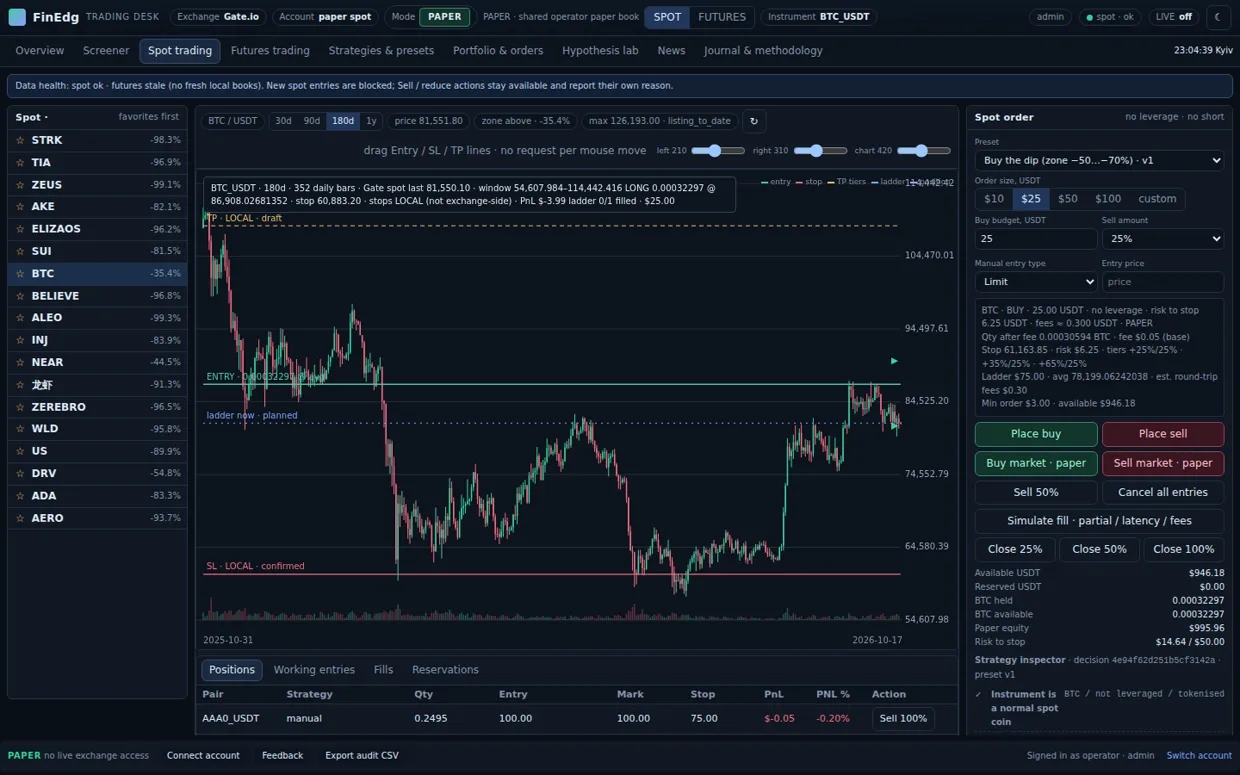
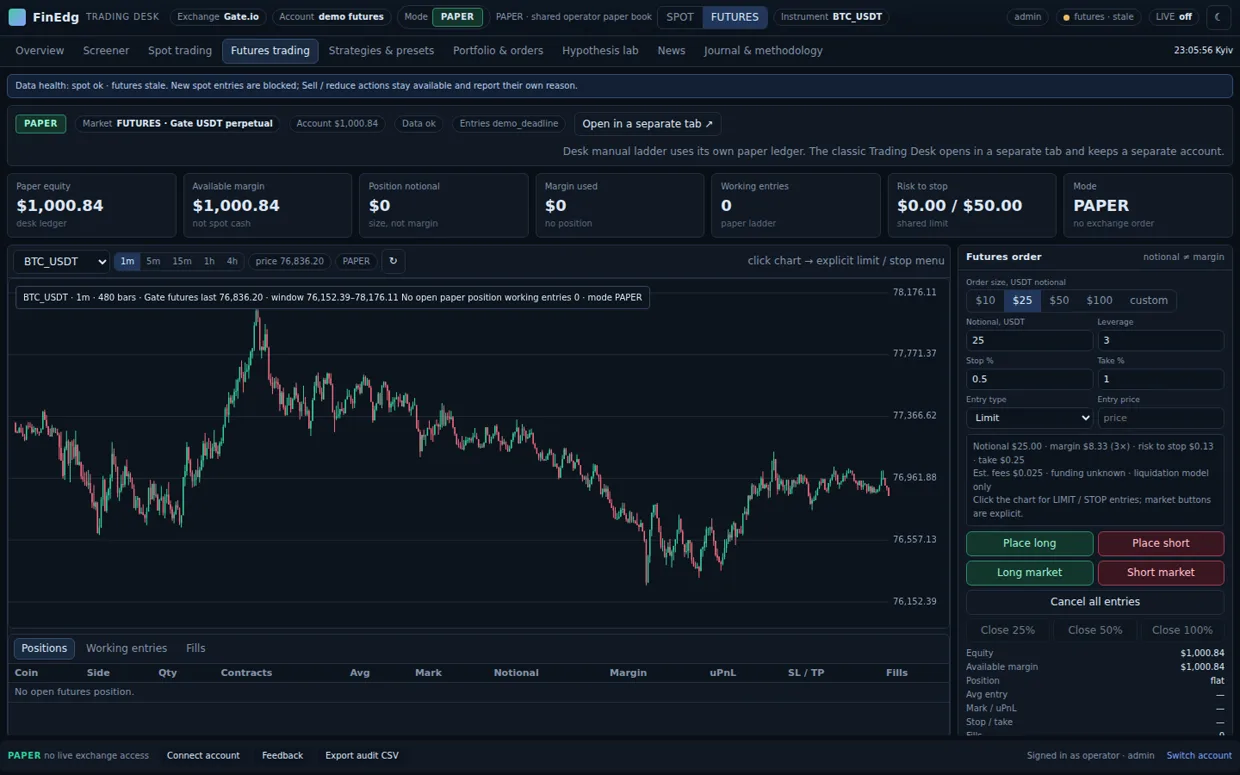
Both screenshots show paper accounts. The data-health line is part of the interface: when a feed is stale it stays visible instead of being hidden.
🛠️ What it is for
Practise the order, not the opinion
A plan is only real when it has a size, an entry, a stop and a take. The ticket forces all four before anything is placed.
See fees before the result
A $25 paper buy shows the modelled fee, the risk to the stop and the break-even move on the same line as the buttons — so a small target is visibly eaten by costs.
Learn what a ladder does to risk
Several rungs, adds against the move and partial closes change the average price and the total risk. On paper that lesson costs nothing but attention.
⚙️ The stack, stated plainly
| Layer | What is used |
|---|---|
| Runtime | A Python service on the standard library and a plain browser interface — no framework and no build step. |
| Market data | Public Gate quotes and candles. There is no private account or order feed, which is exactly why reconciliation is done against the local ledger. |
| Storage | Per-account JSON and SQLite state under a mounted volume, with a bounded size per demo account. |
| Auth | The existing FinEdg session cookie, verified by signature; the role decides shared operator book or isolated demo book. |
| Delivery | Published through the web server with the application on loopback, no-store caching and crawler-exclusion on the app path. |
| Evidence | 36 desk tests green on 30 October 2026, plus the dated acceptance records listed on this page's sources. |
🔑 How to open it
| Address | Who | Sign-in | What you see |
|---|---|---|---|
| /desk/ | Anyone with a FinEdg account | Google or Microsoft — the same account you use on this site | Your own $10,000 paper account, spot and futures |
| /terminal/ | Operator console | FinEdg account with the admin role | The chart terminal on the shared paper book |
There is no separate desk password. The desk has no password of its own because it has no separate identity: it uses your existing FinEdg sign-in and nothing else.
⚠️ When this does NOT work
Gate only, for now.
Only Gate instruments are connected. Nothing here proves the same behaviour on another venue.
No private feed.
We do not read your exchange account or order history, so reconciliation compares the paper book with public market data — not with a broker statement.
The queue is not modelled.
Maker priority, queue position and partial fills are approximations. Slippage is a model, not a measurement.
A basket is sequential.
Multi-leg baskets are executed one leg after another; atomicity across markets is not promised.
No automatic grids.
Automatic grids, martingale and strategy merging are deliberately absent from this build.
Paper money is not an income forecast.
A green paper day says the plan was executable, not that it is profitable in live markets.
❓ Questions
Do I need an exchange account for the desk?
No. The desk is a paper simulator. Sign in with Google or Microsoft through the FinEdg account you already have; no exchange key is requested or stored.
Is my paper balance shared with other people?
No. Each signed-in person gets a separate paper account with its own orders, positions, journal and presets. Only the operator account sees the shared paper book.
What happens when the paper book disagrees with the market?
New entries are blocked and the reconciliation state is shown. Nothing is deleted; an operator resumes entries explicitly, and the name is recorded.
Does the desk send orders to an exchange?
No. Order placement to an exchange does not exist in this build. The footer states PAPER, and the live switch is off with the reason displayed.
Desk repository documentation and dated acceptance records: paper-only mode, per-user $10,000 demo account, separate spot and futures ledgers, local stops, entry halt on disagreement, single executor lease. Test run 30 October 2026: 36 desk tests passed. Screenshots taken 30 October 2026 from the paper session shown. Terminal figures: its own specification page, reviewed 2026-10-30.
Not financial advice. Paper results do not guarantee live results. Leveraged products can lose more than the margin posted.