🖥️ The FinEdg Terminal
One chart, one paper account, no keys.
finedg.com/terminal is our chart trading workspace: eight Gate perpetual markets on one screen, a manual ticket that draws entry, stop and take levels straight on the chart, three strategy runners, and a paper account that survives a restart. It sends no exchange orders — there is no API key and no order client inside the build.
🎯 What you get
The terminal is not a landing page with a chart picture. Every control on it changes a local paper ledger, and every number on the screen is either a market quote with its observation time or a value computed from that ledger.
Chart and depth together
Second and minute candles, executed trades and the near side of the order book on the same canvas. The depth divider can be dragged, and areas the feed did not return stay hatched instead of being invented.
A ticket you can draw
Market, capped limit and stop-market entries; reduce-only; stop, take and trailing levels. Clicking the chart picks the price, and the level becomes a line you can move — a request is only sent when you let go.
Strategies that run
A drawn parallel channel (three points or horizontal) and an EMA drop/rebound runner. Active geometry is frozen: a new draft is drawn differently and never silently amends the running plan.
A ladder, not a single bet
The hypothesis engine keeps several rungs on one coin, adds against the move, trails in three stages and owns a separate account, so a level plan is not squeezed into a one-position-per-coin broker.
Rules written down
$250 per order, $750 of reserved and open notional, five positions, a $25 marked-plus-realised loss stop. The server rejects the order even if a caller bypasses the interface.
A report, not a screenshot
Open coins, pending and cancelled orders, fees and net result per closed position, per-strategy attribution and a CSV export. Times are shown in Kyiv time and the column set says which values are unknown.
🧩 What the software is made of
| Module | What it does |
|---|---|
| Chart workspace | 1-second and 1-minute candles, trades, near-book depth, price and time axes that zoom and pan independently. |
| Manual ticket | Market, capped limit and stop-market orders; reduce-only; stop, take and trailing distance; price picked on the chart. |
| Channel runner | Draws a parallel channel by three points and trades its lower and upper bands; screen width against modelled costs and protects a breakdown. |
| EMA drop runner | Sampled about once a second: a 30-second drop window, then a causal EMA20 rebound check. Versioned separately from the older tick cohort. |
| Hypothesis engine | Multi-position paper engine: rungs on both sides, staged trailing, its own ledger — built because a single-position broker cannot hold a ladder. |
| Ladder specifications | Operator levels are stored as percentages and rebuilt around the current price, so one plan can be applied to another coin. |
| Feed hub | One public Gate endpoint fans eight near-book subscriptions into the browser; the reconnect budget is counted, recharged and then stops the feed instead of spinning. |
| Live position panel | Read-only snapshot of exchange positions produced by a separate runner. The keys stay on that runner, not in this application. |
| Orders & report | Overview, open orders, pending, cancellation history, gross and fees per closed position, CSV export, Kyiv timestamps. |
| Account profile | $1,000 virtual equity, $250 per order, $750 reserved plus open notional, five positions, $25 loss stop, no refill or reset action. |
🖼️ The terminal as it runs
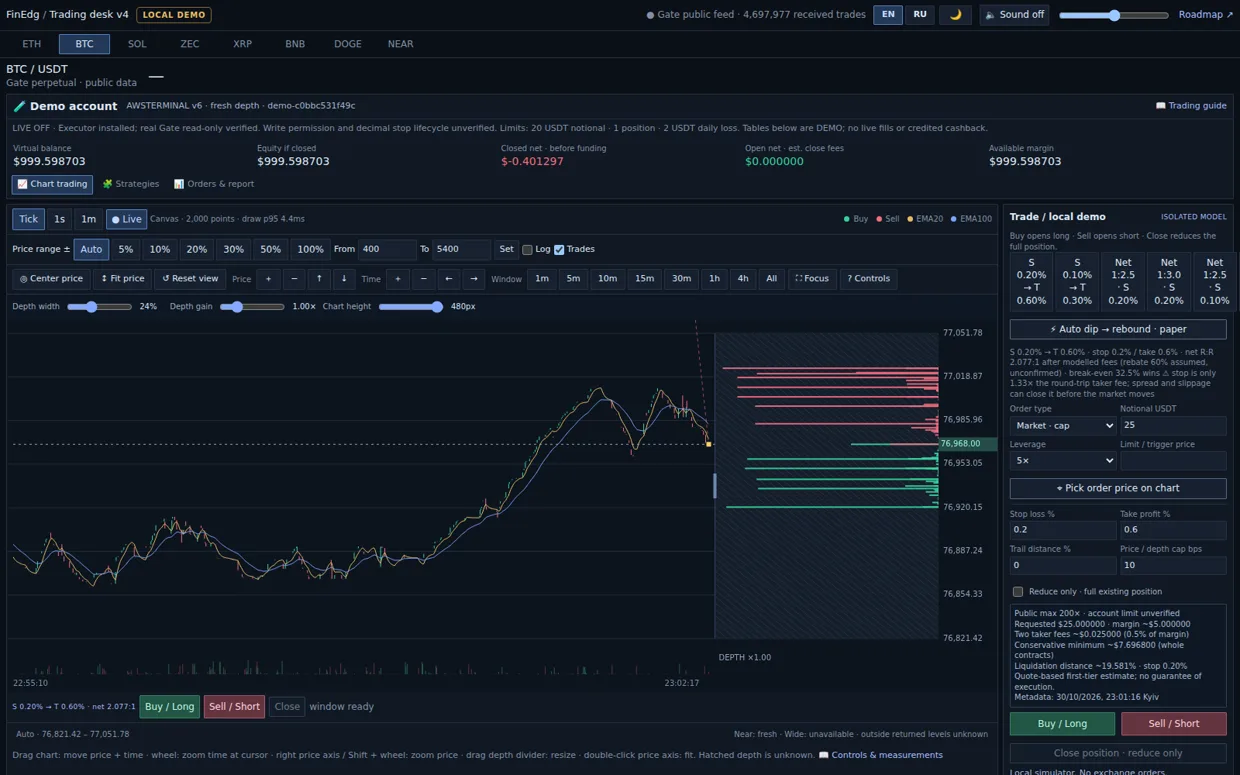
The screenshot is one session of the paper account. It is not a result, an offer or a forecast.
🛠️ What it is for
Planning a trade, not placing one
You see where an entry sits against the book, what a stop costs and what a take needs before money is involved.
Testing a level ladder
Rungs, adds against the move and a three-stage trail can be run for hours without an exchange account — and the ledger survives a restart, so the test is inspectable afterwards.
Reading what costs do
At the quoted 0.075% taker fee per side, a round trip costs about 30% of the initial margin at 200x before spread and slippage. That arithmetic is why the terminal refuses a stop that sits beyond the estimated liquidation.
⚙️ The stack, stated plainly
| Layer | What is used |
|---|---|
| Runtime | A Python gateway on the standard library and a browser canvas interface. No front-end build step, so what is served is what was reviewed. |
| Market data | Public Gate contract endpoints and one public market-data socket. No account API, no trading permission, no key. |
| Storage | A local SQLite ledger plus JSON state and CSV exports, written on a mounted volume rather than the system disk. |
| Delivery | The application listens on loopback only and is published through the web server; the address is gated by the FinEdg account session. |
| Evidence | 51 engine and feed-hub tests (release record, 16 October 2026) plus browser checks on desktop and mobile at 360, 390 and 430 px. |
🔑 How to open it
| Address | Who | Sign-in | What you see |
|---|---|---|---|
| /terminal/ | Operator console | FinEdg account with the admin role (Google or Microsoft) | The full chart terminal on the shared paper book |
| /desk/ | Anyone | Google or Microsoft through the FinEdg account | Your own $10,000 paper account: spot and futures |
| /finedg/console | Anyone | None | A read-only console whose commands print figures already published on this site |
If the chart terminal answers with the desk instead of the chart, the account you signed in with is a demo account — that is the gate working, not an error. The desk is the paper surface a visitor can use today.
⚠️ When this does NOT work
Paper is not the exchange.
Fills are simulated from the observed book. A real book can move between the click and the fill, and nothing here proves otherwise.
Funding is unknown.
Perpetual funding is not modelled, so a long-held paper position is not the same as the same position on an exchange.
Liquidation is an estimate.
The liquidation level is computed from a quote-based first-tier model and labelled as such; it is not an exchange quote.
Stops can slip.
A stop triggers on an observed quote. A gap can execute it worse than planned or not at all.
The queue is not real.
Latency is modelled (about 51 ms) and maker priority is not represented, so slippage figures are approximate.
A running strategy is not an edge.
Our own published testing culled most drop-buying variants. A live-looking arc on a chart is a session, not a verdict.
❓ Questions
Does the terminal place real orders?
No. The build contains a paper account and a local order engine. There is no exchange API key and no order-placement client, and the LIVE switch is off with the reason displayed.
Which markets does it cover?
Eight Gate perpetual contracts — BTC, ETH, SOL, ZEC, XRP, BNB, DOGE and NEAR — on public market data. The leverage limits shown are the exchange's public instrument maxima, not a verified account tier.
Can I open it with my own account?
The chart terminal is an operator console today. Anybody with a Google or Microsoft sign-in can open the paper desk, which gives a separate $10,000 paper account per person.
What happens when the feed stops?
Entries are blocked instead of being filled on stale prices, gaps are hatched on the chart, and unknown depth is never invented.
Release record of the terminal build, 16 October 2026: 51 engine and feed-hub tests, demo profile of $1,000 / $250 / $750 / five positions / $25 loss stop, 0.075% taker per side, eight Gate instrument maxima observed 16 October 2026. Screenshot taken 30 October 2026 from the paper session shown. Desk figures: its own specification page, reviewed 2026-10-30.
Not financial advice. Paper results do not guarantee live results. Crypto derivatives can lose more than the margin posted.